Porte d'Or
A premium redesign in two phases, delivered in one week.
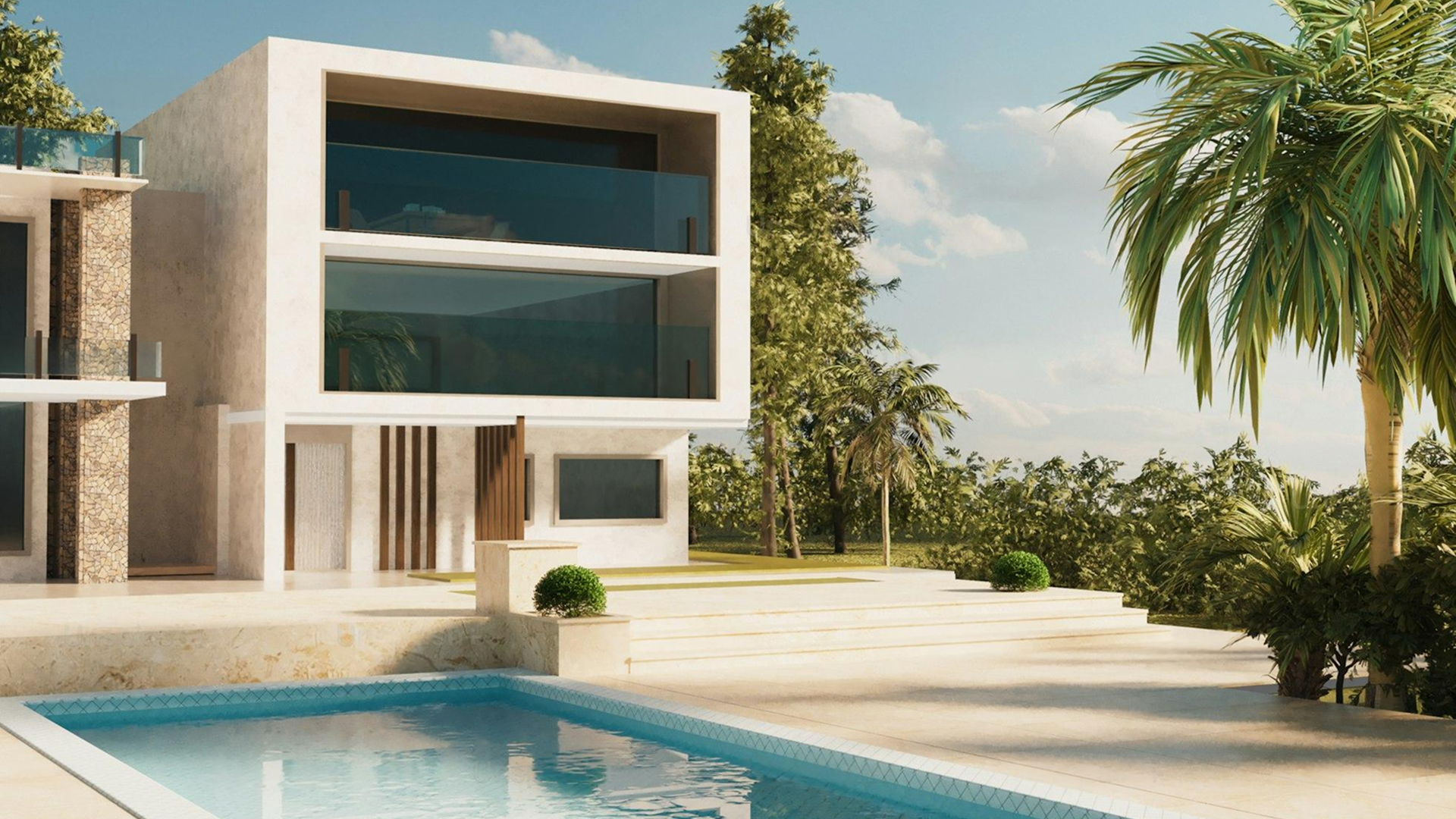
Align what Porte d'Or is worth with what its storefront shows. A rebuild of
the identity, the site, the copy, and the art direction. A revenue simulatoras a lead magnet. Three markets, two acts, one week for the ultra-premiumredesign.Results
+62%
qualified leads over 90 days
70%
of visitors use the simulator
+80%
increase in lead conversions
1
week of production
How we took Porte d’Or from “our website is holding us back” to “our website is what convinced them.”
Phase one: a strategic rebuild that stopped leads from slipping away and introduced a revenue simulator as the site’s lead engine.
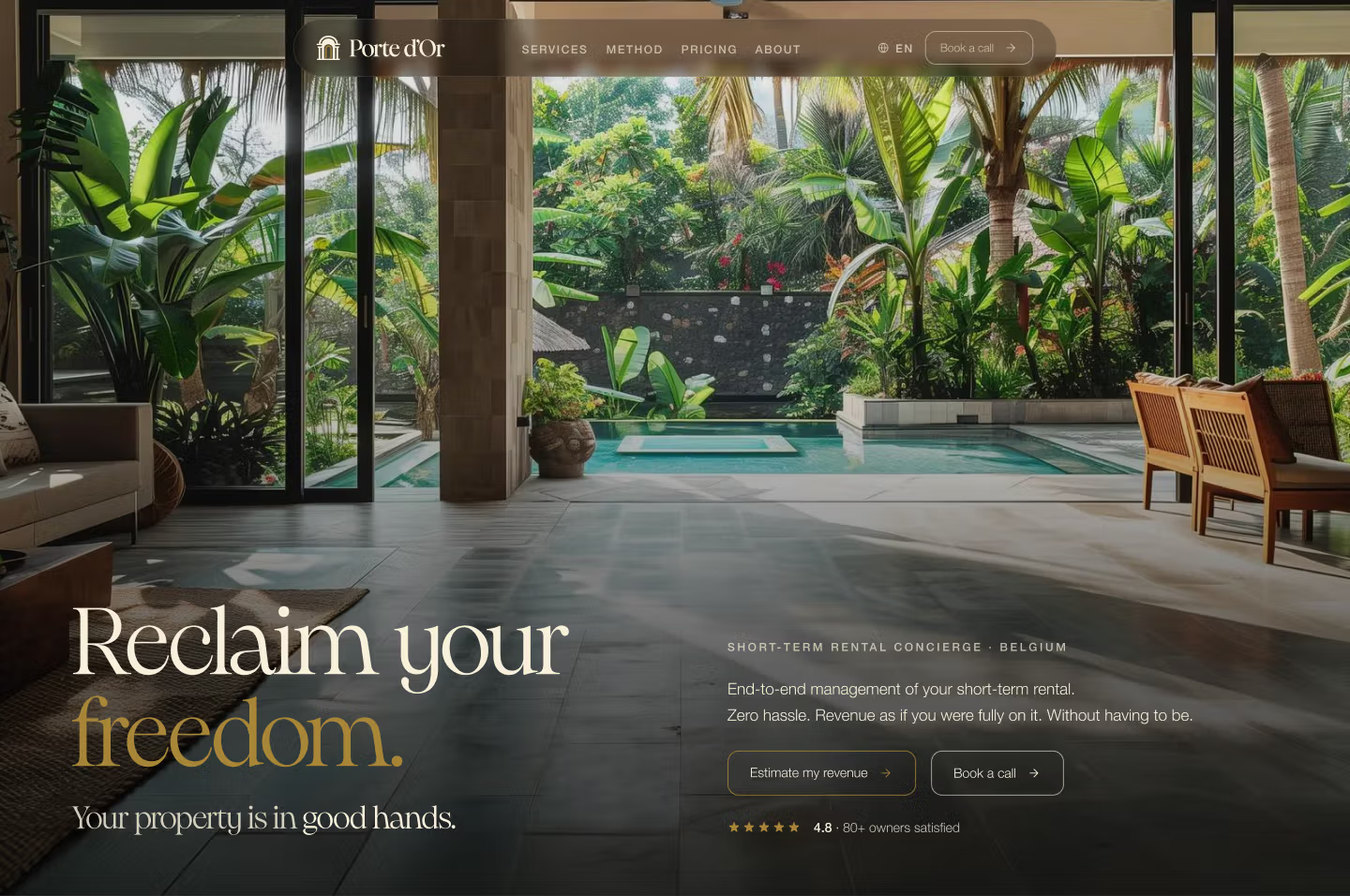
Phase two: a fully bespoke redesign, delivered in one week, that finally aligned the brand with the level of service it had been providing all along.
Porte d'Or is a premium short-stay concierge service founded in 2021 by Ema and Noah. Based in Belgium, they also operate in France and Senegal. Their craft: taking full rental management of their owners' apartments off their hands, with a level of exactingness that sets them apart in a market saturated with generic platforms. Three markets, a curated set of properties, and one obsession: making every stay an experience the traveler remembers.
A good concierge shows in a thousand details. A reply in twenty minutes, a traveler briefed before arrival, an apartment reset between every check-in. Everything Porte d'Or did, day in, day out.
Except for every owner who ended up entrusting their property to Ema and Noah, there were ten, sometimes more, who left before the first call. Not for lack of interest. For lack of signal.
The signal the site sent back: amateur. Dated visual, hacked-together layout, photos with no direction, broken mobile. A prospect landed on it and saw "small", "improvised", "not for me" before they ever saw Porte d'Or.
But Porte d'Or's audience is not an amateur audience. Entrusting a property to a concierge means entrusting a key, an income, and an image. Nobody does that with a brand that doesn't breathe rigor. Premium rates need a storefront that justifies them. So does a premium service. And here, nothing did.
Porte d'Or had built a brand worth its price. Their site said the opposite.
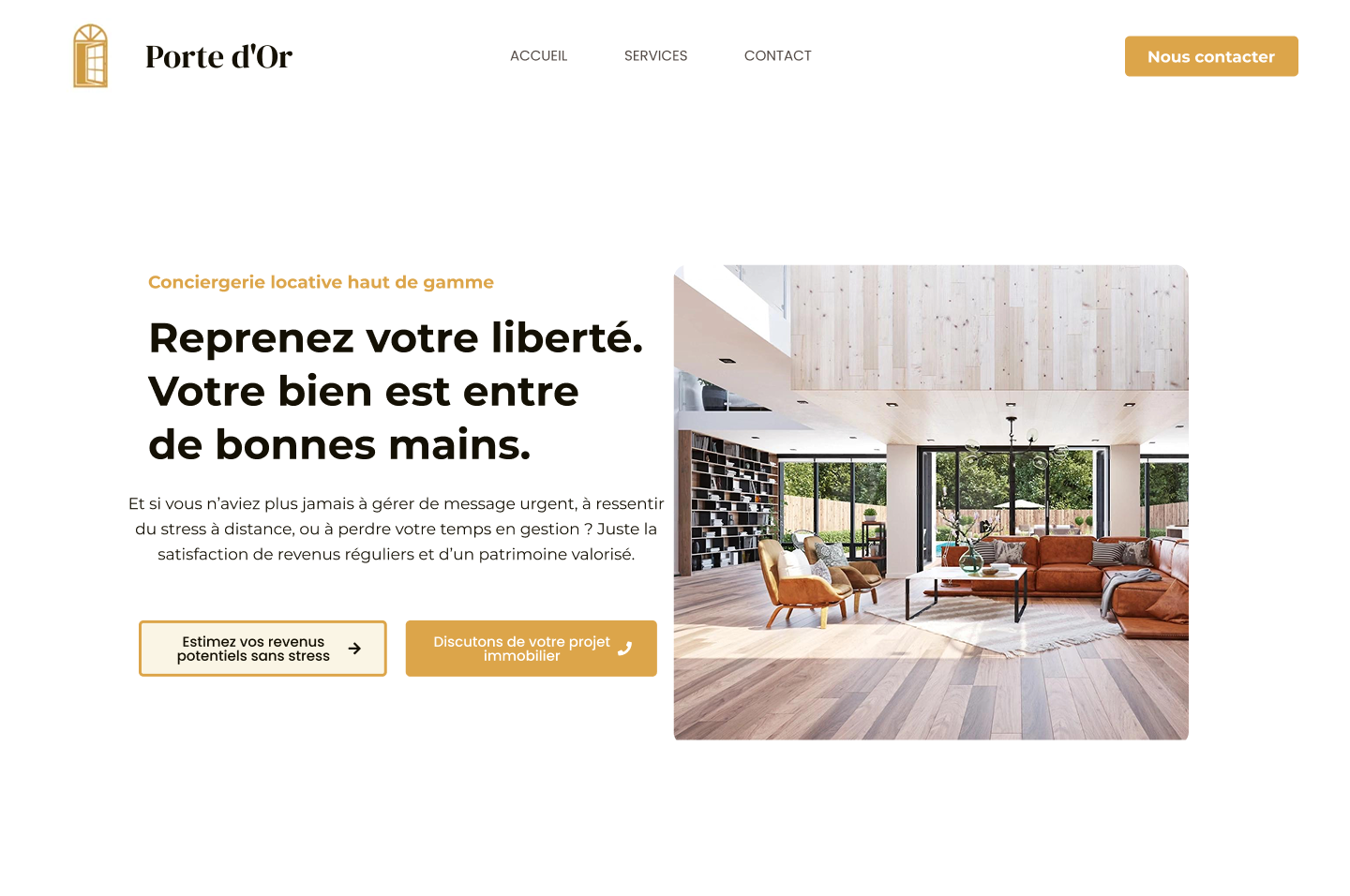
Before. After.
No commentary. Here is what a prospect saw, then what they see today.
The challenge
Rebuilding a site is a familiar exercise. Rebuilding the storefront of a brand worth more than it shows, much less so.
Ema and Noah's brief wasn't "make us look nice". It was: *align what we're worth with what we show. And do it without losing conversion along the way.*
Three non-negotiable constraints:
- The site had to look like what Porte d'Or is worth.
- It had to qualify prospects before the conversation began.
- It had to evolve with the offer, without breaking everything.
All of it while respecting the reality of a young brand, one that couldn't afford a misstep.
The approach
You don't rebuild a site. You rebuild the coherence between what a brand is, and what it lets people see.
In practice, that meant three things, in this order.
First, we rebuilt the brand itself. Logo, palette, typography, tone of voice, editorial principles. Before a single mockup, we took a position. Because a site that has to tell a brand's story needs that brand to know what it's telling.
Then, we designed the lead-generation system. Not as a bonus, as the backbone. The revenue simulator wasn't bolted on at the end of the project: it was thought through first, and the rest of the site was built around it.
Finally, we architected it modular. Every section is isolated. When Porte d'Or opens its traveler offer, you add, you don't rebuild. The ability to evolve is part of the deliverable.
This wasn't a design project. It was a structure project.
The rebranding
Before redrawing a brand, you listen to it. What it does, what it says, what it has become, and what it wants to become.
The result: an identity system built around three principles.
- Warmth: because entrusting a property to someone assumes trust above all.
- Exactingness: because the audience doesn't forgive sloppiness.
- Restraint: because real luxury doesn't shout.
A tightened palette: Golden Brass and Charcoal Teal, set on Ivory Beige and Slate Grey neutrals. An editorial typography. A monogram that condenses the brand into a single mark. A complete brand book, built to hold for five years.
The site
We wanted a site an owner could scroll through on a coffee break, understand in two minutes, and decide to send a message within the next five. No more.
That's what we delivered. A single page, fifteen sections, a clear promise at every scroll tier. Hero that sets the trust. Simulator that turns curiosity into a number. Method that reassures. Guarantees that disarm the classic fears (who pays for cleaning, what if a traveler breaks something, what if I want my property back). Transparent pricing. A form that lands in Notion in real time

At the heart of the site: the revenue simulator
This is the piece that changes everything. An owner arrives, hesitates, isn't sure yet whether they want to send a message. They see the simulator, think "I've got two minutes", fill it in. At the end, a number. Their revenue potential, calculated on their real property.
Meanwhile, in Notion, a record has been created. Name, city, property type, surface, profile. When Ema opens her inbox the next morning, she isn't getting an email from a window-shopper. She's getting a lead ready to talk.
The decision that changed everything
On the Porte d'Or site, the revenue simulator appears before the price grid. That's no accident.
When a prospect hits the prices before they've imagined their revenue, their brain calculates a cost. When they meet the simulator first, their brain calculates a gain. From there, the prices are no longer an expense. They're a commission on a projection the prospect just made themselves.
It's a five-centimeter decision in the wireframe. It changed the nature of the whole journey.
"Several owners told me it was the site that convinced them to trust me." — Ema, Co-founder of Porte d'Or
Two things to know
First: rebuilding a premium storefront isn't a site project. It's a structure project. And structure is built with people who have done it enough times to know where the ten wrong turns are, not with an operator discovering the terrain. The difference costs money, and it shows.
Second: a project like Porte d'Or runs to a few thousand euros, not tens of thousands. The exact figure depends on scope, and we give it to you during the Reveal call. It's expensive if you think "site". It's negligible if you think "commercial machine running for five years".
A poorly exposed brand costs more, every day, than a project that sets it straight once.
What the client says
I wanted a beautiful website that could be launched quickly, allowing me to test my idea without spending months on it. The result: we did even better than that.
The Porte d’Or website helped me land my first clients, instantly set myself apart from my competitors, and put prospects at ease from the very first seconds.
Several homeowners told me that the website was what convinced them to trust me. It played a huge role in launching my business. Thanks for this gem!
Ema
Co-founder, CEO
Like what you see? Let's talk about your project.
Book a callNext project
Scarla
Turning an IT recruiter into a recognizable brand.